Excursion to Scott Turnerbreen
The class gathered at UNIS at 9 am to begin suiting up for the scooter drive to Scott Turnerbreen, a glacier not far from town. During this outing, not everyone got to ride a scooter. The plan was to put half the students in the bandwagon (a big green tank-like vehicle with tracks that looks like its indestructible and could drive anywhere) and the other half in sledges that were pulled by big "yeti" scooters. I quickly volunteered to drive one of the scooters and found it to be quite a challenge once we got out into the field.
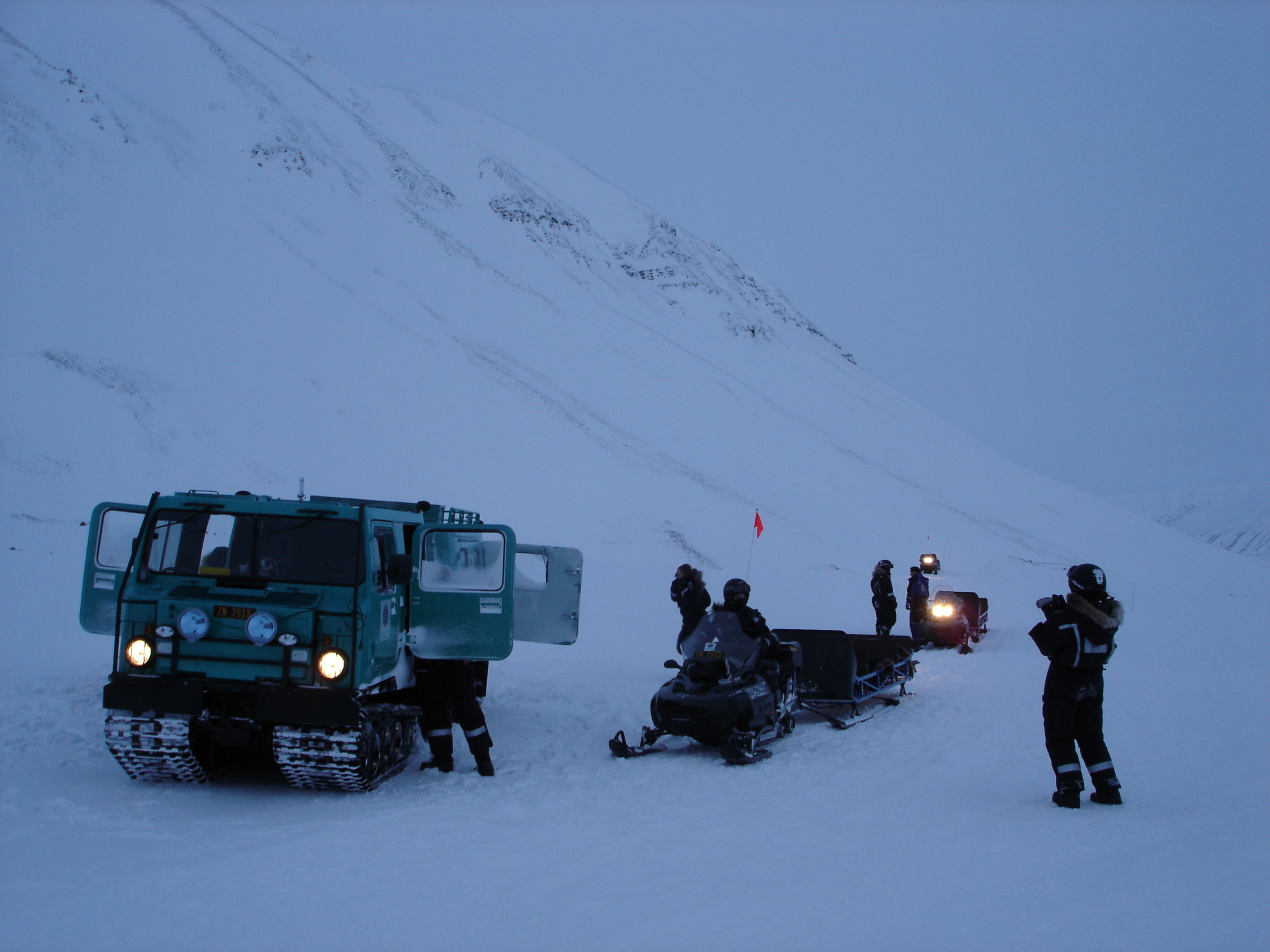
Although we proceeded slowly and cautiously, the scooter was really difficult to control in some cases. If you've ever pulled a heavy trailer behind a vehicle, you know what I mean. Reminds me pulling a stock trailer with a rambunctious bull that tosses his weight side to side...you can't predict the motions of your trailer, and sometimes it makes you think that you're going to flip over! I was the first of the three yetis on the trail, following behind the bandwagon driven by Kåre Johansen. The bandwagon's deep snow ruts I was driving over sometimes made for a bumpy ride. Deep snow impeeded the progress of the group, as several scooters got stuck in the snow. More than once the sledges had to be unloaded and students had to do a lot of digging and walk. The journey there proved to be good experience despite all the work it too to free stuck scooters. We got really warm digging them out.
It was difficult to see any disctinct signs of the glacier because everything was covered in snow, and low stratus clouds and a bit of snow made everything look white in all directions. The area we were in appeared to slope up the mountain and was fairly flat. We dug a snow pit and proceeded to gather data to characterize the snow that had accumulated on top of the glacier. We measured the dept of snow pack to the ice surface (170 cm), measured the temp profile (-15˚C at the surface and warmed to -4.9˚C at the ice surface), and grain size and water equivalent in the snow along the same profile.

In addition to the field work, we entered an dry englacial water channe (ice cave) commonly explored by tourists and researchers. During the melt season its filled with rushing water, and evidence of water erosion and downcutting could be seen throughout the cave. Gave us all an totally new appreciation and understanding of how complex glaciers are, and the hydrological systems that are inside the ice. It reminded me of other caves I've been in. It had stalactites of ice, and small and huge rooms. In some cases we had to crawl on our hands and knees for long distances. It was much warming inside the cave, and in a few places you could see layers of ice and rock. Below is a picture of an area rich in ice-embedded pebbles and sediments. Dean, a really funny Brit from Swanzea, is in the picture. He's about 6'4," so it gives you some perspective of the size of the cave.

posted by Jon Rask @ 10:06 PM


0 Comments:
Post a Comment
<< Home